Free Beginner Crochet Snowflake Pattern with Picot Edges
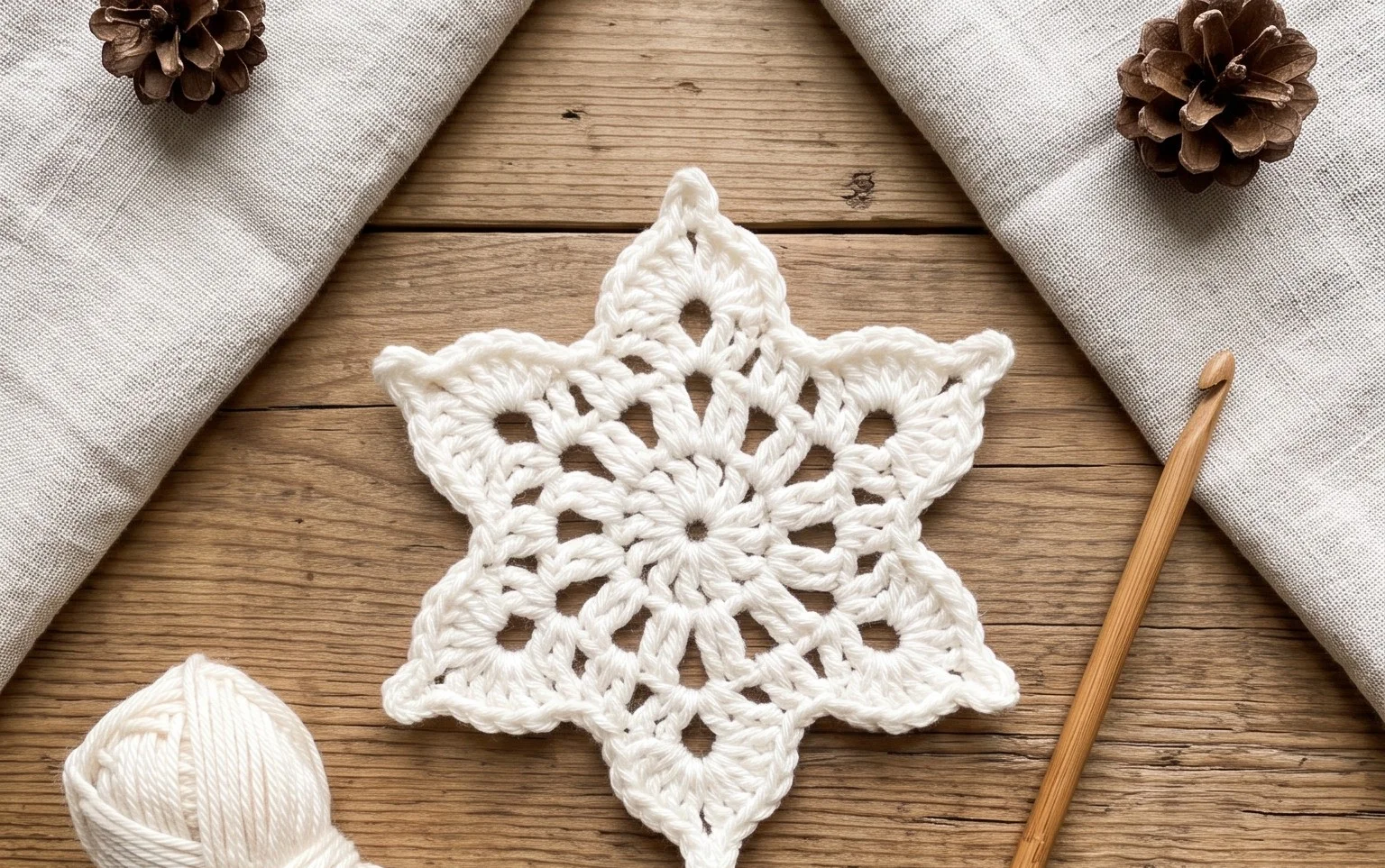
Fine cotton yarn gives a crocheted snowflake a light, lacy feel, with points that look lovely against a window or tucked into a holiday gift. This beginner-level project suits anyone learning to crochet, as well as gift makers and home decor fans who want a handmade decoration without a long commitment. The small motif is satisfying to watch take shape as the center grows into a six-point design. You will work with familiar stitches such as chains and slip stitches, then use small picot details to form the snowflake’s tips. The pattern also gives you a chance to practise even tension and count repeats, so each point stays balanced. A finished snowflake can be displayed on its own or made in a few colors for a simple seasonal set.
Why You’ll Love This Pattern
A firm square of cotton yarn is useful at the sink, easy to wash, and quick to crochet between larger projects. This beginner-friendly dishcloth uses single crochet throughout, so you can focus on keeping the edges straight rather than learning a complicated stitch pattern.
The 30-stitch width makes the fabric easy to count, and the simple rows are a good way to practise even tension. One ball of worsted cotton is usually enough, and the pattern works well with leftover cotton as long as you have about 100 yards in total.
The plain rows were easy to follow, and my finished cloth felt sturdy without being stiff. I used a marker to keep track of the row count.
— Jamie, sample maker
Pattern Overview & Skill Level
- Skill Level: Beginner. You need to know how to chain and single crochet.
- Approximate Time: 1½ to 2½ hours, depending on your pace and how often you stop to count.
- Construction: A flat square worked back and forth in rows, then secured and shaped with light blocking if needed.
- Finished Dimensions & Sizing: About 7½ by 7½ inches (19 by 19 cm) when the stated gauge is met. Cotton yarn and individual tension can change the final size slightly.
Materials & Supplies Needed
- Yarn: About 100–120 yards (91–110 m) of worsted-weight cotton yarn, also called medium weight or #4. Use one color, or join a new color at the end of a row. Cotton absorbs water and holds up well to frequent washing.
- Hook: 5.0 mm / H-8 crochet hook. Use a size that gives you a dense but flexible fabric.
- Notions: Tapestry needle for weaving in the starting and finishing tails, scissors, ruler or tape measure, and a stitch marker if you want to mark the first stitch of a row.
- Gauge: 16 single crochet stitches and 16 rows measure 4 inches (10 cm) in a relaxed, unblocked swatch. Adjust your hook if your swatch is much larger or smaller.
- Substitutions: A smooth cotton blend can replace 100% cotton, but check the yarn label for washing instructions. Linen-cotton yarn is also suitable and may feel firmer. Acrylic is less absorbent and can feel different against dishes. A heavier or thinner yarn changes the finished size and may require a different hook.
Stitch Guide & Abbreviations (US Terms)
- ch = chain.
- sc = single crochet. Insert the hook in the indicated stitch, yarn over and draw up a loop, yarn over again and pull through both loops.
- st / sts = stitch / stitches.
- rep = repeat.
- tch = turning chain. In this pattern, ch 1 at the start of a row does not count as a stitch.
The stitch pattern is plain single crochet. Work into both top loops of each stitch unless the instructions say otherwise. The turning chain is only for height, so do not crochet into it at the end of the next row.
Step-by-Step Pattern Instructions
Dishcloth
- Foundation: Ch 31. Keep the chain relaxed so the bottom edge does not pull in.
- Row 1: Sc in the second ch from the hook and in each ch across. Turn. (30 sts)
- Row 2: Ch 1, sc in each st across. Turn. (30 sts)
- Rows 3–10: Rep Row 2 for each row. Each row has 30 sts. Turn after every row.
- Rows 11–20: Rep Row 2 for each row. Each row has 30 sts. Measure the work if you want to check that the fabric is staying square.
- Rows 21–30: Rep Row 2 for each row. Each row has 30 sts. Do not add a stitch at the row ends; the turning chain does not count as a stitch.
- Fasten off: After Row 30, cut the yarn, leaving a tail about 6 inches (15 cm) long. Pull the tail through the last loop to secure it.
Finishing
Thread the tail onto a tapestry needle. Weave it through several stitches on the wrong side, change direction, and weave through a few more stitches so it stays secure during washing. Weave in the starting tail in the same way. Lay the cloth flat and measure it. If the edges curl, dampen the fabric and smooth it into a square; let it dry fully before using it.
Care & Washing Instructions
- Wash cotton dishcloths in warm water, up to 40°C (104°F), with similar colors; follow the yarn label if it gives a lower limit.
- Dry flat when practical, or tumble dry on low if the yarn label allows it; high heat can shrink cotton.
- Reshape the damp cloth into a square and smooth the edges by hand; use light blocking rather than stretching the fabric.
Pro Tips & Common Mistakes to Avoid
- Keep a relaxed, even tension in the foundation chain. If it is tighter than the following rows, use a hook one size larger just for the chain, then switch back to the 5.0 mm hook.
- Count the 30 stitches at the end of each row. A stitch marker placed in the first stitch can help you find the last stitch on the return row without accidentally working into the turning chain.
- Weave each tail through the back of several stitches and change direction once. A short tail tucked through only one stitch can come loose after repeated washing.
- For a larger cloth, add an even number of chains and work the same number of single-crochet rows as the number of stitches across. This uses more yarn; measure your remaining ball before starting a substantially larger square.
Frequently Asked Questions
Can I use a different yarn fiber?
Yes. Cotton or a cotton blend is the most practical choice because it absorbs water and tolerates regular washing. Acrylic can make a softer cloth but may absorb less effectively. Check the yarn label and make a small swatch, since fiber and yarn thickness affect the finished feel and dimensions.
How do I make the dishcloth smaller or larger?
For a smaller cloth, chain fewer stitches and work fewer rows. For a larger one, add stitches and rows. Keep the row and stitch counts close to equal for a square, and remember that a larger cloth needs more yarn. The stated 100–120 yards is for the 30-stitch by 30-row version.
Is this pattern suitable for a first crochet project?
Yes, if you can make a chain and single crochet. The main challenge is keeping 30 stitches in every row. Count often for the first few rows, and check that the cloth measures close to square before fastening off.
May I sell dishcloths made from this pattern?
You can sell your finished work if the pattern designer’s terms allow it. Check the terms that came with the pattern before listing items, and write your own product description rather than presenting the pattern instructions as your own.
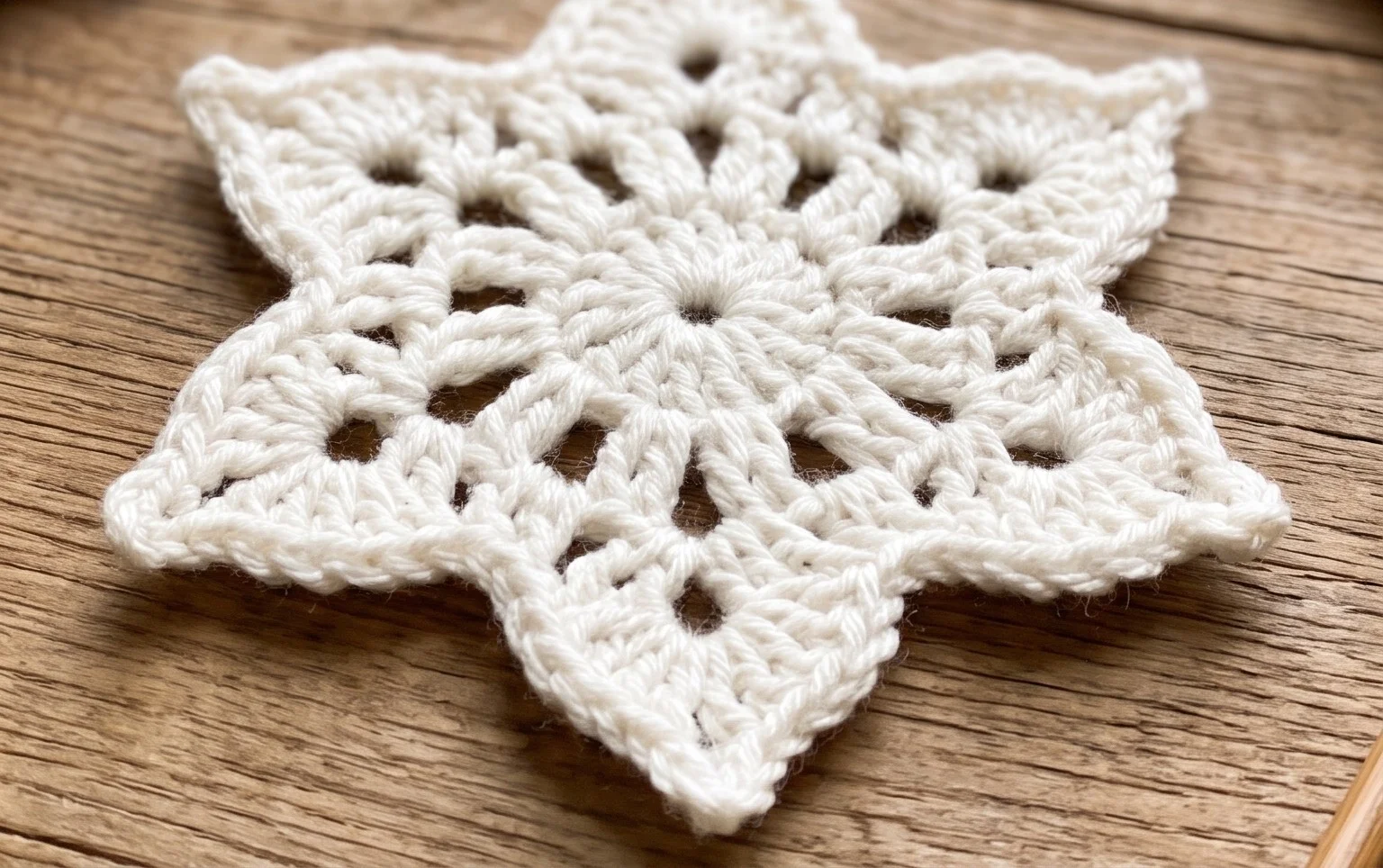
Your finished snowflake has a crisp, delicate shape that brings a handmade touch to a window, tree, or wrapped gift. For a simple variation, try a soft blue or silver yarn instead of white, keeping the same stitch pattern so the points stay clear. If you make one, share a photo on Pinterest or your favorite social media platform; it is always nice to see how different yarn colors change the finished look. You can also browse more free crochet patterns on the blog for small projects to make between larger pieces. Keep your snowflake flat while it dries after blocking, and it will be ready to display or give away.